




- Written by: admindigiroutes
- August 31, 2026
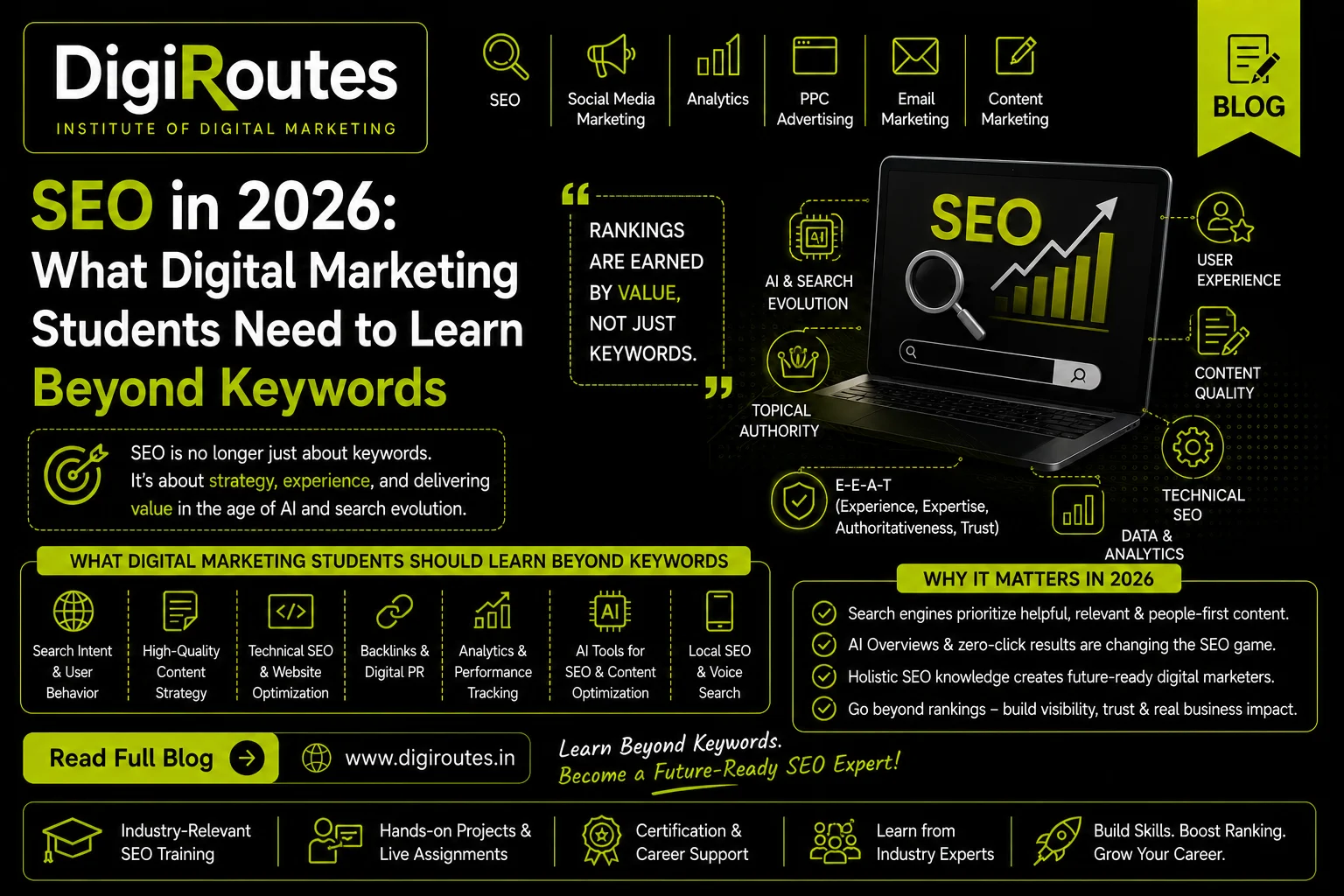
SEO in 2026: What Digital Marketing Students Need to Learn Beyond Keywords
SEO has changed dramatically.
A few years ago, beginners often associated SEO with keywords, backlinks and ranking on Google’s first page.
Those fundamentals still matter, but modern SEO requires a much broader understanding of websites, content, search intent, user experience, technical SEO and AI-powered search.
Google’s current guidance confirms that traditional SEO fundamentals remain important for AI search experiences such as AI Overviews and AI Mode.
So what should a digital marketing student learn about SEO in 2026?
What Is SEO?
Search Engine Optimization (SEO) is the process of improving a website and its content so that search engines can discover, understand and potentially show it for relevant searches.
The goal is not simply to rank for keywords.
The real goal is to attract the right audience and help them complete their task.
1. Learn Search Intent
Before optimizing a page, understand what the searcher wants.
For example:
“What is SEO?”
→ Informational intent
“Best digital marketing institute in Pune”
→ Commercial investigation
“DigiRoutes digital marketing course”
→ Navigational/branded intent
“Digital marketing course fees”
→ Commercial investigation
Matching content to intent is more useful than forcing a keyword into every paragraph.
2. Master Keyword Research
Keyword research remains important, but students should move beyond single keywords.
Learn:
- Search volume
- Search intent
- Keyword difficulty
- Long-tail keywords
- Keyword clusters
- Related searches
- Question-based queries
- Competitor analysis
Instead of creating one page for every keyword variation, build comprehensive content around a topic when it makes sense
3. Learn On-Page SEO
Important areas include:
- Title tags
- Meta descriptions
- Heading structure
- URLs
- Image optimization
- Internal links
- Content structure
- Keyword relevance
- Search intent
A properly optimized page should also be easy for humans to read.
4. Understand Technical SEO
Technical SEO is where many beginners become uncomfortable, but you don’t need to be a developer to understand the fundamentals.
Learn:
- Crawling
- Indexing
- XML sitemaps
- Robots.txt
- Canonical URLs
- Redirects
- Broken links
- Mobile usability
- Page experience
- Core Web Vitals
- JavaScript SEO basics
Google recommends making content accessible to crawling systems and maintaining a good page experience.
5. Learn Internal Linking
Internal links help users discover related content and help search engines understand relationships between pages.
For example, a blog about SEO careers could link to:
- Digital marketing career opportunities
- Digital marketing courses
- AI tools for marketers
- Practical training
- Internship opportunities
This creates a stronger content ecosystem.
6. Learn Content Strategy
Modern SEO is closely connected with content quality.
Students should learn how to create:
- Topic clusters
- Pillar pages
- Supporting articles
- Comparison guides
- How-to content
- FAQs
- Case studies
- Local content
Google’s 2026 guidance emphasizes useful, unique, non-commodity content rather than content created simply to manipulate search visibility.
7. Understand AI Search, AEO and GEO
Search is increasingly becoming conversational.
Users may ask:
“Which digital marketing course is best for a beginner who wants practical experience?”
Instead of searching only:
“digital marketing course”
This means marketers should understand how to structure content that clearly answers questions.
AEO generally refers to Answer Engine Optimization, while GEO is commonly used for Generative Engine Optimization.
However, Google explicitly states that there are no special hacks or separate technical requirements needed to appear in its generative AI features. Existing SEO fundamentals remain the foundation.
8. Learn SEO Analytics
An SEO professional needs to measure performance.
Important metrics include:
- Organic clicks
- Impressions
- CTR
- Average position
- Organic traffic
- Conversions
- Engagement
- Indexed pages
Google Search Console is particularly important for understanding how a website performs in Google Search.
9. Build Local SEO Skills
Local SEO is especially valuable for businesses serving specific geographic areas.
Students should learn:
- Google Business Profile
- Local keyword research
- Local landing pages
- Reviews
- NAP consistency
- Local citations
- Location-based content
For example, a digital marketing institute can target searches such as:
- Digital marketing course in Hinjewadi
- Digital marketing institute in Wakad
- Digital marketing classes in Pune
The content should provide genuine local value rather than simply repeating the location.
10. Use AI Without Losing Human Expertise
AI can help with research, outlines, content ideation and repetitive tasks.
But students should not depend on AI to automatically produce hundreds of generic articles.
Google’s guidance warns that generating large volumes of low-value content without adding value can fall under its spam policies.
A better workflow is:
Research → AI assistance → Human expertise → Fact checking → Original examples → Editing → Optimization
SEO Skills Checklist for Students
| Skill | Beginner | Advanced |
|---|---|---|
| Keyword Research | ✓ | ✓ |
| On-Page SEO | ✓ | ✓ |
| Technical SEO | ✓ | ✓ |
| Content Strategy | ✓ | ✓ |
| Internal Linking | ✓ | ✓ |
| Local SEO | ✓ | ✓ |
| Search Console | ✓ | ✓ |
| Analytics | ✓ | ✓ |
| AI Search | ✓ | ✓ |
| SEO Audits | ✓ | |
| Conversion Optimization | ✓ |
Frequently Asked Questions
- Is SEO still worth learning in 2026?
Yes. Google states that foundational SEO remains relevant to its AI-powered search experiences. - Will AI replace SEO professionals?
AI can automate parts of SEO work, but strategy, technical understanding, analysis, content quality and business decision-making still require human expertise. - What SEO skills should students learn first?
Start with search intent, keyword research, on-page SEO, content optimization, internal linking and basic analytics. Then move into technical SEO, local SEO and AI search. - What is the difference between SEO and GEO?
SEO broadly focuses on improving visibility in search engines. GEO is a term commonly used for improving visibility in generative AI search experiences. Google describes generative AI optimization as continuing to rely on core SEO practices rather than requiring a separate set of hacks. - Can beginners learn SEO without coding?
Yes. Beginners can learn a large portion of SEO without coding. Basic HTML, JavaScript and technical concepts become increasingly useful as you progress.
Conclusion :
SEO is no longer just about ranking pages for keywords.
A modern SEO professional needs to understand search intent, content, technical SEO, internal linking, analytics, local search and AI-powered search experiences.
For digital marketing students, learning these skills through practical projects can make SEO much easier to understand and apply.