





- Written by: admindigiroutes
- September 7, 2026
Digital Marketing Roadmap for Beginners in 2026: What to Learn Step by Step
Digital marketing has become one of the most practical career options for students, graduates, freelancers and working professionals. But when beginners search for how to learn digital marketing, they often find a long list of tools and confusing advice.
Should you start with SEO?
Do you need to learn Google Ads first?
Is social media marketing enough?
How important is AI?
The easiest way to learn digital marketing is to follow a structured roadmap instead of trying to master everything at once.
In this guide, we explain a practical digital marketing roadmap for beginners in 2026, from fundamentals to advanced skills.
What Is Digital Marketing?
Digital marketing is the process of promoting products, services or brands through digital channels such as search engines, websites, social media platforms, email, online advertising and other digital platforms.
A digital marketer’s job is not simply to post content or run advertisements. A good marketer understands the target audience, creates the right message, selects appropriate channels and measures business results.
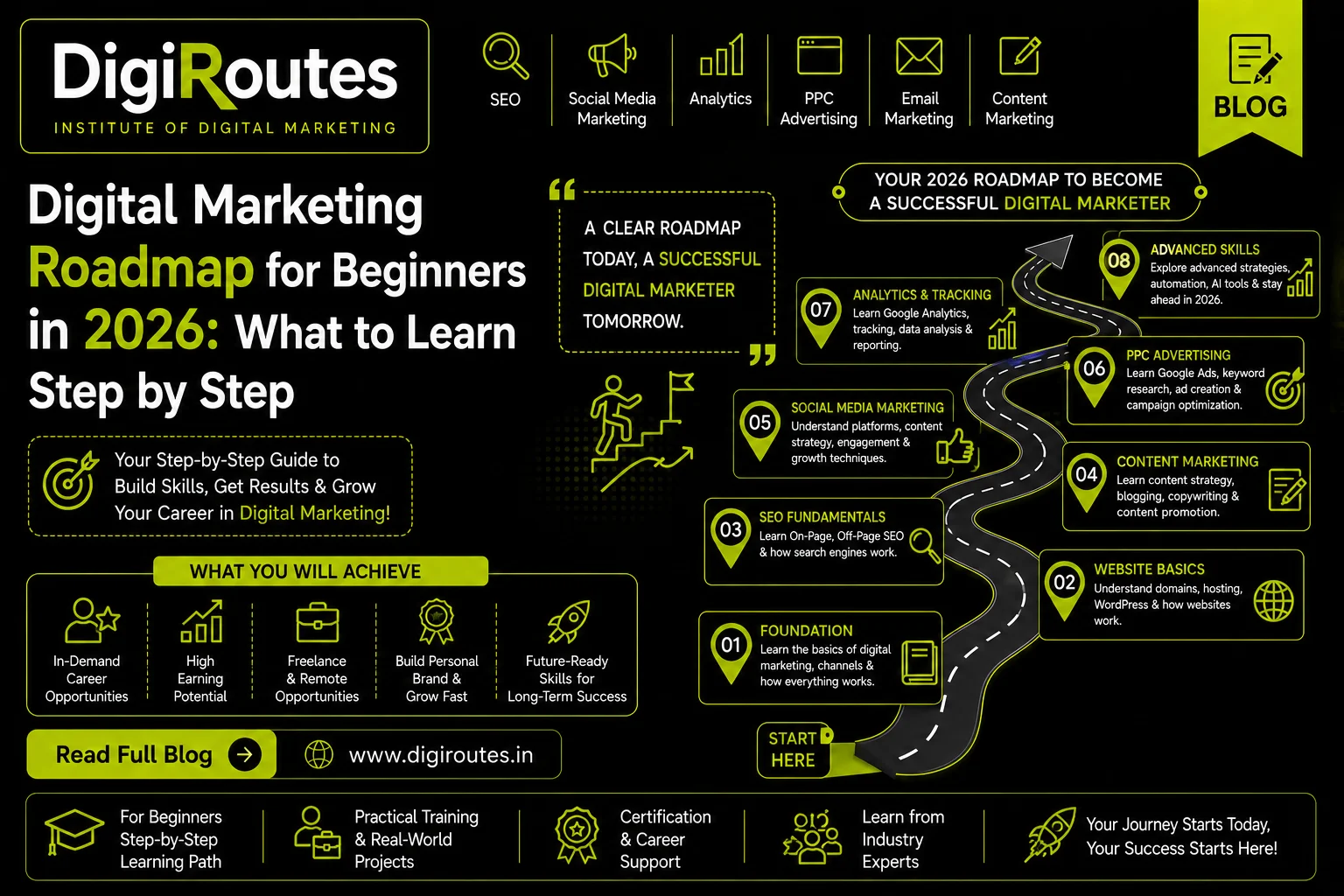
Digital Marketing Roadmap for Beginners
A practical learning path can be divided into these stages:
- Understand digital marketing fundamentals
- Learn website and content basics
- Learn SEO
- Learn social media marketing
- Learn content marketing
- Learn Google Ads and paid advertising
- Learn analytics and reporting
- Learn AI-assisted marketing
- Work on practical projects
- Build a portfolio and start applying for opportunities
Let’s look at each stage.
1. Start With Digital Marketing Fundamentals
Before learning individual tools, understand how digital marketing works.
Start with concepts such as:
- Target audience
- Customer journey
- Buyer personas
- Marketing funnels
- Leads and conversions
- Organic vs paid marketing
- Brand awareness
- Customer acquisition
- Return on investment (ROI)
These concepts make it easier to understand why different marketing channels are used.
2. Learn Website and Content Basics
A website is often the foundation of a company’s digital presence.
Beginners should understand:
- Website structure
- Landing pages
- Calls to action
- User experience
- Basic WordPress
- Website content
- Conversion-focused pages
You don’t necessarily need to become a professional developer. However, understanding how websites work can make you a much more effective digital marketer.
3. Learn Search Engine Optimization (SEO)
SEO is one of the most important digital marketing skills because businesses want to attract people who are actively searching for their products or services.
Learn:
- Keyword research
- Search intent
- On-page SEO
- Technical SEO
- Off-page SEO
- Internal linking
- Local SEO
- Content optimization
- Google Search Console
- SEO reporting
SEO is also becoming increasingly important as search evolves with AI features. Google states that existing SEO fundamentals continue to apply to AI Overviews and AI Mode.
4. Learn Social Media Marketing
Social media allows brands to build awareness, communities and customer relationships.
A beginner should learn:
- Content planning
- Social media calendars
- Platform-specific content
- Reels and short-form video
- Engagement strategies
- Hashtag research
- Social media analytics
- Paid social campaigns
Don’t focus only on posting frequency. Learn how content supports a business objective.
5. Learn Content Marketing
Content marketing helps businesses educate audiences and build trust.
You can learn to create:
- Blog posts
- Social media posts
- Videos
- Infographics
- Case studies
- Landing page content
- Email content
- Educational guides
The goal should be to answer real customer questions rather than simply inserting keywords into an article.
6. Learn Google Ads and Performance Marketing
SEO can take time to generate results. Paid advertising allows businesses to reach targeted audiences more quickly.
Learn the basics of:
- Search campaigns
- Display advertising
- Remarketing
- Keyword targeting
- Ad copy
- Landing pages
- Conversion tracking
- Cost per click
- Cost per lead
- Return on ad spend
The most valuable skill is not merely creating campaigns. It is understanding whether those campaigns are producing profitable results.
7. Learn Analytics and Reporting
A marketer needs to understand numbers.
Important concepts include:
- Website traffic
- Users
- Sessions
- Engagement
- Conversion rate
- Leads
- Cost per lead
- Revenue
- Campaign performance
Learn tools such as Google Analytics and Google Search Console and practise creating simple performance reports.
8. Learn How AI Can Support Digital Marketing
AI is becoming part of modern marketing workflows.
It can help marketers with:
- Content research
- Brainstorming
- Keyword clustering
- Content outlines
- Ad copy variations
- Audience research
- Data analysis
- Creative ideation
- Workflow automation
However, AI should support marketing expertise rather than replace it.
Google’s current guidance emphasizes creating unique, useful, people-first content and warns against producing large amounts of low-value content simply with generative AI.
9. Work on Practical Projects
This is where learning becomes real skill.
Instead of only watching tutorials, create projects such as:
- SEO audit for a local business
- Keyword research project
- Sample Google Ads campaign
- Social media strategy
- Content calendar
- Website optimization project
- Lead-generation campaign
- Analytics report
A practical project also gives you something to show during interviews.
10. Build Your Digital Marketing Portfolio
Your portfolio can include:
- SEO reports
- Keyword research
- Website audits
- Social media campaigns
- Content samples
- Google Ads campaign plans
- Analytics dashboards
- Case studies
Even projects created during training can demonstrate your approach and problem-solving ability.
How Long Does It Take to Learn Digital Marketing?
There is no fixed timeline because digital marketing contains multiple disciplines.
A beginner can start understanding the fundamentals within a few weeks, while becoming confident across SEO, paid advertising, analytics, social media and content marketing requires continued practice.
The key is consistency.
Learn → Practice → Measure → Improve → Repeat.
Which Digital Marketing Skills Should Beginners Prioritize in 2026?
A strong beginner skill set includes:
| Skill | Importance |
|---|---|
| Digital Marketing Fundamentals | Essential |
| SEO | Essential |
| Content Marketing | Essential |
| Social Media Marketing | Essential |
| Google Ads | Highly valuable |
| Analytics | Essential |
| AI Marketing Tools | Increasingly valuable |
| Website/WordPress Basics | Highly useful |
| Email Marketing | Useful |
| Conversion Optimization | Advanced |
Frequently Asked Questions
- What is the best digital marketing roadmap for beginners?
Start with digital marketing fundamentals, followed by website basics, SEO, social media, content marketing, paid advertising, analytics, AI tools and practical projects. - Can I learn digital marketing without a technical background?
Yes. Digital marketing does not require advanced programming knowledge. Basic website, analytics and technical concepts can be learned gradually. - Is digital marketing a good career in 2026?
Digital marketing continues to evolve as businesses invest in websites, search, social media, advertising, analytics and AI-powered marketing. The strongest opportunities are for professionals who can connect marketing activity with measurable business outcomes. - Should I learn SEO or Google Ads first?
Both are valuable. SEO is useful for long-term organic visibility, while Google Ads can help businesses reach targeted audiences through paid campaigns. Learning both gives beginners a broader understanding of customer acquisition. - Is AI replacing digital marketers?
AI can automate or accelerate many repetitive marketing tasks, but marketers still need strategy, creativity, audience understanding, critical thinking and business knowledge. Learning to use AI effectively is becoming an important part of modern digital marketing.
Conclusion :
The best way to learn digital marketing in 2026 is not to chase every new tool.
Build strong fundamentals first, learn the major marketing channels, practice on real projects and use AI to improve your workflow.
A structured learning path can help beginners move from “I want to learn digital marketing” to “I can actually execute a digital marketing campaign.”
For students looking for practical digital marketing education, DigiRoutes can be positioned as the next step for learning these skills through structured training and hands-on practice.