




- Written by: admindigiroutes
- August 10, 2026
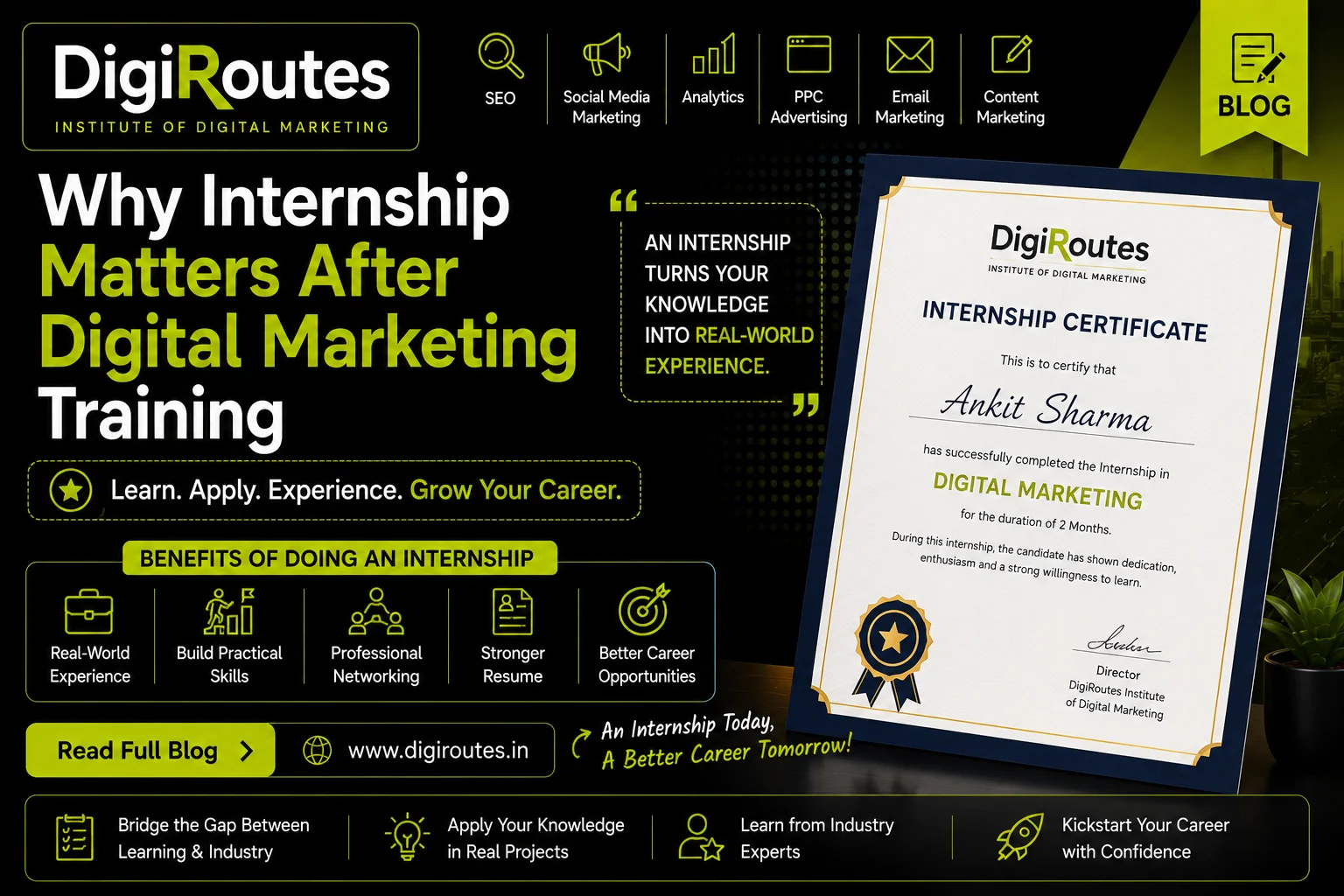
Why Internship Matters After Digital Marketing Training
The digital marketing industry is evolving faster than ever. Every year, businesses adopt new technologies, AI-powered tools, automation platforms, and data-driven marketing strategies to stay ahead of the competition. While classroom learning builds a strong foundation, employers today expect candidates to demonstrate practical experience before hiring them.
This is exactly why an internship matters after digital marketing training. An internship bridges the gap between theory and practical implementation by allowing learners to work on live projects, real client campaigns, analytics dashboards, SEO audits, paid advertisements, content creation, and social media management.
Students searching for the Best Institute For Digital Marketing in Hinjewadi should look beyond certificates and course modules. The real value comes from institutes that provide internship opportunities, live projects, career guidance, portfolio development, and placement support.
At DigiRoutes, students receive industry-oriented Digital Marketing Training in Hinjewadi, practical assignments, internship experience, and career mentoring, all preparing them for today’s competitive digital economy.
Why Internship Matters After Digital Marketing Training
Practical training helps students apply theoretical concepts in real-world scenarios. It improves campaign management skills, SEO execution, social media marketing expertise, ad optimization abilities, and problem-solving capabilities.
A quality Digital Marketing Training Institute in Hinjewadi should provide:
- Live projects
- Internship opportunities
- Real campaign exposure
- SEO implementation practice
- Google Ads campaign setup
- Social media strategy execution
- AI tools training
- Placement guidance
Practical learning builds confidence and makes students job-ready faster.
Why This Topic Matters
Digital marketing has become one of the fastest-growing industries globally. Companies hire professionals who can deliver measurable business results—not just explain marketing concepts.
Employers often ask candidates questions like:
- Have you managed SEO campaigns?
- Have you worked on Google Ads?
- Can you optimize a website?
- Have you generated leads?
- Do you know GA4?
- Have you worked with AI marketing tools?
- Can you handle client communication?
An internship answers “Yes” to many of these questions.
Without practical experience, even talented students may struggle during interviews.
This is why institutes offering internships consistently produce more employable graduates.
What is a Digital Marketing Internship?
A digital marketing internship is structured practical training in which students work on live marketing activities under the guidance of industry experts.
Typical internship responsibilities include:
- Website optimization
- Keyword research
- Technical SEO
- Local SEO
- Google Business Profile optimization
- Social media management
- Paid advertising
- Email marketing
- Blog writing
- AI content optimization
- Landing page creation
- Analytics reporting
- Competitor research
- Campaign optimization
Instead of reading about marketing, students actually perform marketing.
Internship vs Classroom Learning
Classroom Learning | Internship |
Theory-focused | Practical implementation |
Sample examples | Live client projects |
Limited software exposure | Industry tools |
Basic assignments | Real business tasks |
Exams | Performance evaluation |
Certificates | Work experience |
Academic understanding | Professional confidence |
Both are important, but together they create complete learning.
Key Concepts and Fundamentals
1. Learning by Doing
Practical implementation improves knowledge retention significantly.
Instead of memorizing SEO concepts, interns:
- Optimize websites
- Fix technical errors
- Improve rankings
- Track keyword movement
Learning becomes meaningful.
2. Problem Solving
Every client has unique marketing challenges.
Interns learn to solve problems such as:
- Low website traffic
- Poor conversion rates
- High advertising costs
- Weak local visibility
- Low social media engagement
These experiences cannot be replicated through theory alone.
3. Portfolio Development
Recruiters appreciate portfolios more than certificates.
A strong portfolio may include:
- SEO reports
- Website audits
- Google Ads campaigns
- Social media creatives
- Keyword research
- Analytics dashboards
- Content strategy
- Landing page
4. Industry Tool Experience
Students gain hands-on experience with tools like:
- Google Analytics 4
- Google Search Console
- Google Ads
- Google Keyword Planner
- SEMrush
- Ahrefs
- Canva
- WordPress
- ChatGPT
- Gemini
- Looker Studio
- Meta Ads Manager
Employers highly value practical tool experience.
Benefits and Advantages
Benefits of an Internship After Digital Marketing Training
1. Faster Career Growth
Students become productive from day one.
2. Better Interview Performance
Real project experience builds confidence.
3. Practical Skills
Students understand:
- SEO
- PPC
- Social Media
- Content Marketing
- Email Marketing
- Automation
- AI Marketing
4. Higher Salary Potential
Companies often offer better packages to candidates with internship experience.
5. Strong Professional Network
Internships connect students with:
- Mentors
- Agencies
- Business owners
- Marketing managers
- Recruiters
Networking creates future opportunities.
6. Better Freelancing Opportunities
Students learn how to:
- Find clients
- Deliver projects
- Build proposals
- Manage communication
Many begin freelancing even before completing their course.
How It Helps Businesses
Businesses also benefit when they hire internship-trained professionals.
Advantages include:
- Faster onboarding
- Lower training costs
- Better campaign performance
- Higher productivity
- Better ROI
- Improved digital presence
- Data-driven decision making
- Better customer engagement
Job-ready marketers help businesses grow faster.
Step-by-Step Guide
How an Internship Completes Digital Marketing Training
Step 1
Learn marketing fundamentals.
Step 2
Understand digital marketing channels.
Step 3
Practice using industry tools.
Step 4
Work on live client projects.
Step 5
Analyze campaign performance.
Step 6
Optimize campaigns using data.
Step 7
Build a professional portfolio.
Step 8
Prepare for interviews.
Step 9
Apply for jobs confidently.
Step 10
Continue learning throughout your career.
Latest Trends and Strategies 2026
Digital marketing continues to evolve with technology. Students completing internships should gain exposure to the latest industry trends, including:
1. AI-Powered Marketing
Using AI tools for:
- Content ideation
- SEO assistance
- Ad copy creation
- Workflow automation
- Customer support
2. Search Everywhere Optimization
Marketing now extends beyond Google to AI platforms, voice assistants, and answer engines.
3. First-Party Data Strategies
Businesses increasingly rely on owned customer data for personalization.
4. Video-First Marketing
Short-form video dominates user engagement across platforms.
5. AI-Assisted SEO
Combining human expertise with AI improves productivity while maintaining quality.
6. Local SEO Growth
Businesses continue investing in Google Business Profile optimization, reviews, and location-based search visibility.
Industry Statistics and Insights
Recent industry observations consistently show:
- Digital marketing roles continue to grow across industries.
- SEO remains one of the highest ROI marketing channels.
- Businesses invest heavily in content marketing and paid advertising.
- Local SEO drives significant customer inquiries for service-based businesses.
- AI adoption is accelerating across marketing workflows.
- Candidates with practical project experience generally receive more interview opportunities than those with only certifications.
These trends reinforce why internships are increasingly becoming an essential part of professional digital marketing education.
Common Challenges and Solutions
Challenge | Solution |
Lack of confidence | Practice through internships |
No portfolio | Build projects during training |
Interview fear | Mock interviews |
Limited software knowledge | Hands-on tool training |
No work experience | Internship programs |
Difficulty getting first job | Placement assistance |
Expert Recommendations
Industry experts generally recommend choosing a training institute that offers more than classroom education. Before enrolling, evaluate whether the institute provides:
- Live projects
- Internship opportunities
- Updated curriculum
- AI marketing tools
- Experienced mentors
- Career counseling
- Resume building
- Mock interviews
- Placement support
- Advanced certifications
Continuous learning and practical application remain the keys to long-term success in digital marketing.
Why Choose DigiRoutes Institute of Digital Marketing
Students looking for the Digital Marketing Training Institute in Hinjewadi should consider practical learning opportunities that prepare them for real careers.
DigiRoutes focuses on industry-oriented education through:
- Practical Digital Marketing Training Programs
Students work on live assignments rather than only classroom exercises. - SEO Training
Comprehensive training covering technical SEO, on-page optimization, off-page SEO, local SEO, and content optimization. - Social Media Marketing
Hands-on campaigns across major social platforms. - Google Ads & Paid Marketing
Campaign creation, optimization, bidding strategies, and performance analysis. - Content Marketing & Copywriting
Develop persuasive content for websites, blogs, advertisements, and social media. - WordPress Website Basics
Understand website creation, optimization, and content publishing. - AI Tools for Digital Marketing
Learn how AI supports productivity while maintaining high-quality marketing practices. - Internship & Practical Projects
Gain real-world experience through supervised projects. - Career Guidance & Placement Support
Resume preparation, interview training, and career mentoring. - Freelancing Training
Learn how to build an independent digital marketing career.
Key Takeaways
- Practical learning is essential for digital marketing careers.
- Internships bridge the gap between education and employment.
- Live projects improve confidence and technical skills.
- Portfolios often matter more than certificates.
- AI tools are becoming essential marketing skills.
- Internship experience improves interview success.
- Businesses prefer job-ready professionals.
- Continuous learning is critical for career growth.
Frequently Asked Questions
- Why is an internship important after digital marketing training?
An internship provides real-world experience, improves practical skills, builds confidence, and increases employability. - Does internship experience help in getting a digital marketing job?
Yes. Employers generally prefer candidates who have worked on live projects and understand industry tools. - Which skills improve the most during an internship?
Students strengthen SEO, Google Ads, social media marketing, analytics, content marketing, communication, reporting, and campaign optimization. - How long should a digital marketing internship be?
Most internships range from two to six months, depending on the training program and learning objectives. - Is an internship better than certification?
Both are valuable. Certification demonstrates knowledge, while an internship demonstrates practical capability. Together, they provide the strongest career foundation. - Can I get a digital marketing job without an internship?
Yes, but internship experience significantly improves your chances by demonstrating practical skills. - Do internships include live projects?
Quality internship programs typically involve real client campaigns, website optimization, analytics, and content creation. - Is SEO included in digital marketing internships?
Most comprehensive internships include SEO, keyword research, technical optimization, content strategy, and performance tracking. - Are internships useful for freelancing?
Absolutely. Practical experience helps build a portfolio, understand client requirements, and deliver measurable results. - What should I look for in a digital marketing institute?
Look for experienced trainers, practical learning, internship opportunities, updated curriculum, AI tools, certifications, and placement support.
Conclusion :
Understanding why internships matter after digital marketing training is essential for anyone planning a successful career in digital marketing. While classroom education builds theoretical knowledge, internships transform that knowledge into practical expertise through live projects, real campaigns, industry tools, and client-focused problem-solving.
For students searching for the Best Institute For Digital Marketing in Hinjewadi, choosing an institute that combines structured learning with internships, mentorship, and placement assistance can make a meaningful difference in career outcomes. Practical experience not only improves technical skills but also builds confidence, strengthens portfolios, and prepares learners to contribute effectively from their first day on the job.
Call-To-Action
If you’re ready to build a successful digital marketing career, choose a learning path that goes beyond theory. Join DigiRoutes to gain hands-on experience through practical assignments, live projects, internship opportunities, AI-powered marketing training, career guidance, and placement support. Equip yourself with the skills employers value and take the first step toward becoming a confident, job-ready digital marketing professional.